Wednesday, 7 May 2014

This sure has been a fun few weeks. If by fun you mean stressful that is.

But first lets focus on the good stuff. This 1920's Chicago project. I was super excited for this project since I first heard about it. First of all the 1920's theme gives its own cool challenge, and second of all you had the choice to design either a character, an environment or a vehicle. It was pretty obvious I'd do a character but it's nice to be given the choice.

I'm pretty happy with how my design turned out in the end.
I was going for a showgirl kind of idea. She ended up far more Harley Quinn than I originally intended but I dont really mind that. Always up for more madness. I think my digital painting is getting better, most of the nitpicks and crit I've got about this picture has been pose or outfit related. (I wish someone crit the outfit BEFORE I did the final guh)

The most of my stress this past two weeks hasn't been this project though. No this one was super fun and awesome. I've been having to redo my work in Visual Design. That, is pretty stressful. Fear of failing and all that. I don't mind. I managed to redo all this work far better than I did the first time. Comparison.
 Drawing from the start of the year.
Drawing at the end. Serious improvement right?
Ultimately I'm glad I've improved. Even if it turns out I'm still failing visual design after this rework, I've got better. I cant hope for more than that. I know that drawing from life like this isn't my strong point. It's the designing. But I am getting better.

Sunday, 6 April 2014

Blog Conference 2014

 On Wednesday of this week the entire day was put aside for our Critical Studies work. A whole day about blogs! If I had to review the day in one word, I'd give it a resounding 'Meh'.

 The day was split into multiple sections, with different classes you could choose from. In my case the first two classes I went too were in all honesty boring. I didn't feel as if I learnt much which kind of defeats the entire point. These two tasks were 'Writing for your reader' and 'How to write when you don't want to write'. They felt entirely seperate to our course and unrelated, filled with fairly useless and often contradictory information. When tasks like these aren't engaging or interesting then people in return will stop caring. It really started off the Conference in a bad light and really frustrated me and others.

 Not everything was bad however. The next two tasks 'Being critical in your blogs' and 'Practical strategies for getting on with it' were really good! They were engaging, they were interesting. They ticked every box. I felt as if I learnt something new and actually enjoyed the sessions. MRW :

 This wasn't just the subject matter, although that was significantly better; it was also down to the tutors giving the classes promoting far more discusion between we students and themselves.The first classes didn't do this, just leaving us with some task. This meant everything about these last two lessons was a lot more personal and alot more relatable. We could apply things we learnt more and often get personal advice for our own individual situations. This is good. I like this.

 While I seem to be negative about the day I am not. It's more just averages. What I learnt was extremely useful and the good times were good. It's just a shame that some things were disappointing. I am totally glad that I attended however (as it turns out we were missing over half of the year which is just insane) and I feel that the things I learnt will definitely help out my future blogs.

Tuesday, 1 April 2014

UDK


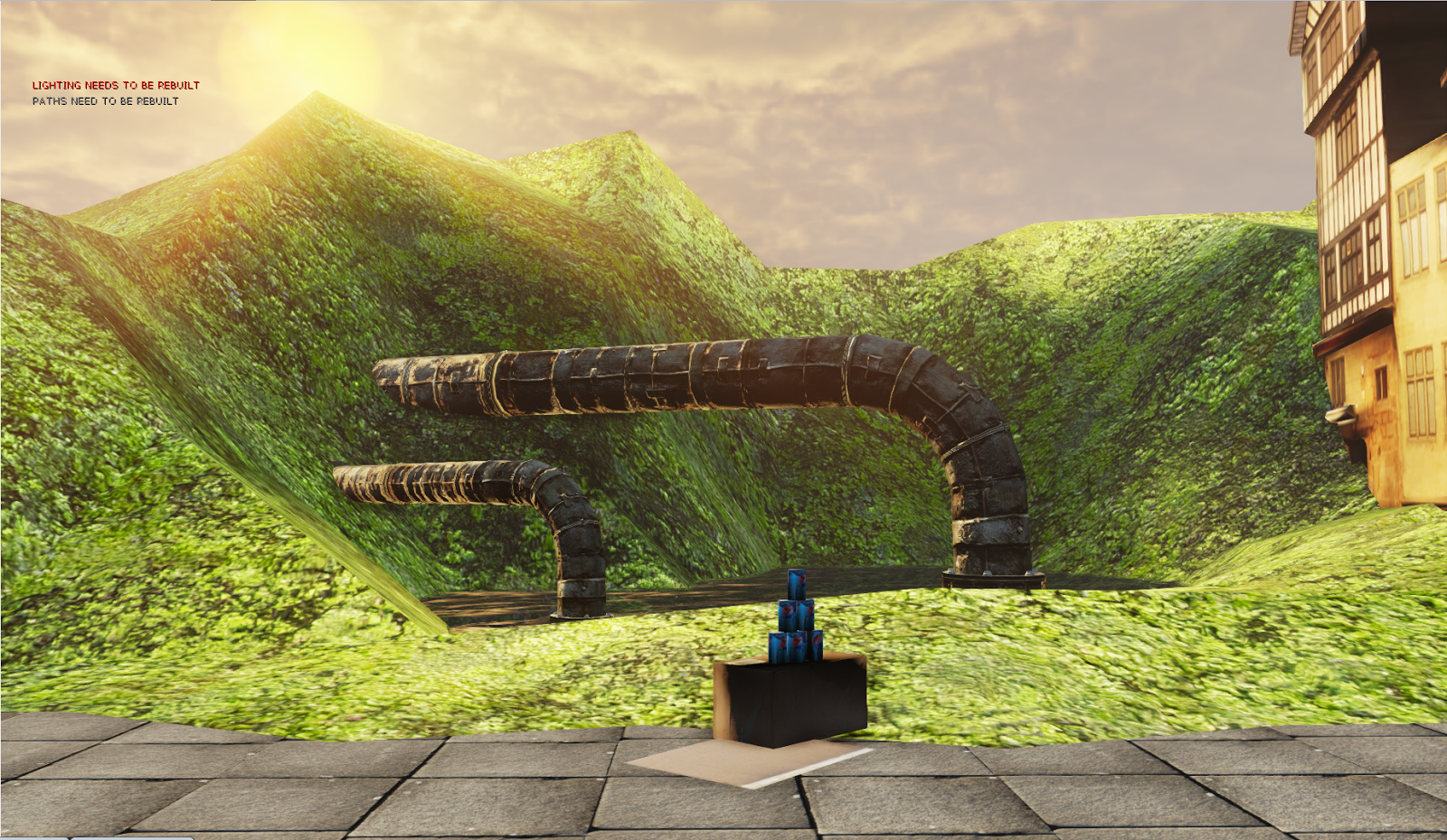
I'm having great fun playing with Unreal Development Kit for Game Production. There's something so satisfying about creating a scene which you can then walk around in. I had to make a scene using the assets of all the other projects we've had to do. 


The issue with this is that my older projects we're exactly built to export so I've had to do a lot of changing. I don't mind though, it's been a learning process. It's made sure that I know how to import into UDK and more importantly how to make assets that work in UDK. 


I'm pretty happy with my scene. The assets don't really match but it's actually all worked out okay.


I think I'm going to add more though. I have all of easter, so I might aswell fiddle abit more and see what other cool things I can find. I do find the best way to find out these things.


And there are still several things I still need to fix. For example all of my trees look like they're on fire. That's something I might want to change.


I've made my gladiator into a statue, standing imposingly above the scene. 


So overall I'm loving UDK. Making scenes is extremely fun and I know I'm going to do more of this. Theres still much more to learn, but there always is.

Wednesday, 26 March 2014

Thursday, 20 March 2014

Art Direction - Bioshock

 In early 2013 many popular games were very... grey. The colour palette was subdued with browns and grey's with the ideal to make the games seem real, gritty and dark. While this may have worked, after some time the gaming audience started to get tired of it.

  So it is March 2013 and you've just started playing Bioshock Infinite by Irrational Games. It seems pretty standard as you play through the first view minutes of the game, very dark and very subdued. Then you open a door and you're presented with this : 


Behold! Colours! I remember very definitely when this game came out the gaming reddit's coming alive with talk of how colourful and bright this game is. And this is not a child's game it just uses colour far more effectively than most games at the time. 

Not only does this view hold colour but it also shows you alot about the game.


The design of the level draws your eye towards the left which is the direction you need to go, with the skyline and the statues pointing sword. This is all subtle as well, no big flashing arrows telling you where you need to be. This image also gives you an idea of the size of Columbia, the flying city, with the buildings in the background.


As you can see the colours use mostly oranges and blues on creams and whites. Orange and blue being obviously complimentary colours making the whole scene pop.


When it comes to lighting the entire scene is very bright. Theres little contrast although there is some. Over all I believe Irrational was trying to create the bright mood. Overall this whole thing does create a very happy and cheerful mood. But I feel it alittle uncanny. It's too bright, too clean. Suspiciously so.

And all of this works together AMAZINGLY! It's important to note that all of this is moving. It's not a static scene. The buildings swaying ever so slightly, cargo travelling down the sky-line, the clouds moving in the back. It all creates a very living real place.

But that is something I would do differently, and this applies to all of Bioshock Infinite. It feels very empty. There's only two or three people hanging around. I'd like to see more people, more activity. Also I'd perhaps move the sky-line up slightly, as it imposes the statue of Comstock center stage.

This whole scene is brilliant however, despite small gripes. I loved this moment, and I know reddit was ablaze with screenshots of this moment. It's awesome just like the game it came from. If you haven't played Bioshock Infinite yet play it already!

Tuesday, 11 March 2014

History 4 B - Indie Blog 2, the Sequel.

 One of the huge things with Indie games in the modern gaming climate is promotion. Many indie game developers now have become public personas able to talk with their fanbase and reviewers in person. With the social media boom this is very easy now and with things like Kickstarter fans can get their voices heard with fabulous ease.

Take for example Markus Persson, also known as Notch, creator of Minecraft. He’s an extremely public personality using Twitter to talk to his fans with this fedora wearing public persona. He self promotes to great success, being able to tell his fans of new projects and keep people interested in his work. Many devs like this get fans themselves as well as fans of their games. At the business side of things this lets them advertise new games and projects, as well as being able to find out their fanbases opinions easily.


Of course sometimes this can backfire. Youtube is central to the indie game community. It gives reviews and publicity to games. Usually this is an amazing thing.


Day One: Garry’s Incident made by Wild Games studio was released in September of 2013 and soon became one of the biggest things in indie games for the time. Not for good reasons. It was immediately hit with terrible reviews. Youtube Critic Totalbiscuit created a review for this game, using a pre-release version he was given by the developers as done with many indie games.


The issue is that he gave the game a terrible review. He was incrediably critical of it. Wild Games Studio instead of dealing with this instead made a false copyright claim against the video to get it removed, and succeeded for a brief time. In Totalbiscuits words on Twitter, "Long story short. Dev sends code, code used to make critique, dev dislikes critique, dev abuses system to censor critique.".


Not only this, but it was also revealed that the studio was giving fake reviews to try and boost its score on the review site Metacritic. When all of these things came to light gamers acted harshly, and now the game has been struck with terrible reviews given a rating of 0.4. This is a huge display of how social networking and youtube can completely ruin a game, instead of giving it fame and attracting fans. This will most likely effect the company for the rest of their career.

As you can see social media effects the indie gaming scene for both the good and the bad. Some developers can and do use the more open connectivity of the industry now to their advantage, and some others need to be careful that EVERYTHING is recorded, even the bad things.  


Reference


Sunday, 2 March 2014

Research Jobs

So we're supposed to be looking at our dream jobs in the industry. Mine would be at Riot Games, working on League of Legends. Doing what? I dont even really mind.

http://www.riotgames.com/careers/senior-concept-artist

This is a link to their demands for a senior concept artist. Of course I wouldn't be looking for that straight away but lets say it's a nice dream. Right now I'm not even sure if I want to go into concept art, maybe into character modelling or animation however many of these jobs have similar demands for Riot.

Now to look at what we need. Of course I need to build up a portfolio of 2d and 3d work. To do that I need more skill in both areas, which hopefully I'll gain via the course and hard work through the next few years. Part of this is getting far more skill in anatomy and with that posing and dynamics. This I'm trying to improve in my free time but obviously I need more work especially if I want to work in the field. I need I also need to show that I can work in a team, which hopefully things such as the 2nd year group project will show gloriously. Personally I think the desire they have for someone creative and mutli-genre I have but of course that will grow and I need to make that show through my portfolio. That means I need a very varied portfolio.

Luckily the step about being a League of Legends gamer is ticked nicely.

As I said I'm not sure if I want to go into concept art. It is a passion of mine, but its also a very hard place to get into. Either way, I'm going to need all manner of skills to even get close to this job.

Friday, 21 February 2014

History 4 A - Independence Day


(This is the start of my rewritten fourth task. I never had any clue I was to make 3 different posts about this! But I'm glad for the chance to re-write it, personally.)

Indie games are awesome. That isn't just a personal opinion. Indie games are absolutely massive in  todays gaming climate. The beautiful thing about Indie games is how well they can fill niche areas and gaps in the market which no  AAA developer would dare tread near.


 With the ease of Steam and Xbox Live Arcade indie games have never been easier to make and sell. Especially now with Kickstarter, Developers now can easily see if a game will be well recieved and get funding based off it. Just see Star Citizen for an example, Kickstarting  up $2,134,374!

Star-Citizen-01.jpg

 But it was not always this way. In the early days of gaming in the era of the Atari 2600 many games were made by one or two people. All you needed was the know-how, and you could easily create a video game and sell it. These independent developers are similar to the ones we have now in a way.

 This is part of the reason for all the extremely weird games of the 2600. Take for example Custers Revenge...  There was such an oversaturation of games because of this.

6a00d83452989a69e201127914c2a828a4-800wi.jpeg

 That and people being able to release games so easily was part of the blame for the great video game crash of 1983. So when Nintendo rose from the ashes like a phoenix they stopped these shenanigans. Nintendo would only let games be published with their seal of approval by using the10NES chip installed inside their Nintendo Entertainment System.

 But this didn't stop unlicensed publishers from trying. These to me are similar to indie games in a way, being separate from the mainstream. They're also really dang weird. These include beauties such as Wisdom Tree's series of Bible related games. 

Bible_adventures.jpg

 Now we move onto the PC, where indie games truly thrive. In the Late 80s games such as Doom and Wolfienstien were released as Shareware. These games were made by tiny groups and gave out the first levels of the game for free requiring payment for the later levels.


 Indie gaming didn't become truly huge start to become as grand as it is today till 2004 with the release of Cave Story. I love the Cave Story story, where the game designer Pixel created this entire game from scratch including the graphics and music. Cave story became a massive hit in Japan, and a massive hit globally once it was translated by fans. It perfectly combined simple gameplay with excellent story, something that will be a recurring theme in the world of Indie gaming.

Cave_Story_3D_(NA).jpg


 Making this game was a great step in Pixel's career, as he has now worked on remakes for various consoles and with many upgrades to his game with large teams. He really showed the world how making games independently could be truly viable again. And In my opinion this sparked the resurgence of indie gaming culture that we now experience today. 

Sunday, 2 February 2014

I thought this would be a good time to finally update my blog again. We had just finished a two week set of workshops, one in 2D and one in 3D. While in 3D we made a simple street scene, which is not all too interesting. But what is interesting is the 2D project where we got to design a vehicle. 


I really enjoyed this project, although it was kind of hard. This is my final piece, and as you can see i've made a submarine robot squid. Thing. I'm really happy with it, especially with this new technique on photoshop. This project was crazy hard, but I think i've done rather well.

 During the project I had that realisation. I'm here to do this course, I want to do all of this. So I've been putting in a tonne of extra work. Every day I'm trying to do some quick sketches. Ideally these would be photoshop practice but my personal graphics tablet has currently died. RIP in peace you glorious device. Till then I've been trying anatomy practice, mostly to see if I can make realistic anatomy WITHOUT reference.


I need alot of work, but I'll get better. That's what this practice is all for.

Saturday, 4 January 2014

Character Design


Wow I haven't posted anything on here for far too long. Well that is about to change!

During the holiday period I did two main things. I re-did all of my final pieces for Visual Design and I worked on a character design project for it aswell. Now the new final pieces are nice but I'm more interested in the character design work.

I love character design. It's the thing I like to do for fun, and it's actually one of the reasons I wanted to do this course! So of course I had alot of fun doing things. Originally the idea I had was to create a Christmas themed evil character, being told to make our character evil!


Trying to make this guy Christmas themed just felt tacky, so I kind of avoided it. I originally imagined candy-cane swords and tinsel based clothing but I'm glad I turned against it. This guy I wanted to look like a powerful King, so of course I gave him the broad body.

I quite like him! I mean, the feeling I had of him manged to go across so thats a success. Now my main focus is on redoing my final pieces. I really hope that I can manage to redo these pieces well enough, but of course I don't know. I feel like I'm doing better, and I can see an improvement in my work. It's definately obvious to me that I need to improve more, and get more confidence in my work. I'll be sure to throw anything I'm truly happy with here. 


Saturday, 7 December 2013

Freemium


 I find it pretty interesting that this limit is going to be put onto Freemium games. Especially now that many newer games for console are starting to adopt Freemium idealologies, and many are starting to include in game purchases. It's good that they're trying to do this, to stop kids from buying tonnes. But of course, gamers will always find a way around these blockades, if they want to.

 I guess this was all coming together, especially due to recent reports that in some games now adopting in game purchases, where some purchases are up to $200 in size. A lot of people were in uproar about this. So it makes sense that they do this. Personally I think that alot more Freemium games will be coming, now that they can exist on consoles. 

Tuesday, 3 December 2013

March of the Ents

So making trees has been pretty awesome. I've really enjoyed it. Tree number one is a beautiful little birch tree. I'm very much proud of this old girl. Honestly, as long as it looks like a tree I think it's totally a success. There is one major thing that has been an issue and that's my model size being several hundred under but really it's looking good. I've had some problems running the line between going over a size limit and just under it. It's much like when you arrive 10 minutes early instead of just on time, which is another thing I do all of the time.


Mr Second Tree is in my opinion not as solid. Which I think is a fine opinion to have. I tried to make a willow tree, because I was really proud of my Birch and partly because I saw a totally awesome willow tree I wanted to make. Now this hasn't ended out as well, personally. But it does look like a tree and is pretty alright, really. I personally think that I just need more alpha layers, or do it a different way that I haven't thought of yet. But hey, it still works.

Sunday, 1 December 2013

History 4 C - Indie History


 In the glorious old days of the Atari 2600 hundred many games were made by a handful of programmers. Anyone with the know-how to make a game filled with bleep-bloops and ham sized pixels could and could release it. That leads to why so many strange games were made for that and the similar consoles of the age. Through time in video games often games were made by these small groups of people passionate about gaming and their creations.

 Even some old games were made from passion. The 1980 arcade game Missile Command was made by progammer Dave Theurer suffering from nightmares about nuclear war. Similarly the 1988 game Wasteland and it's spiritual successor Fallout, both of which having sequels coming soon, come from the ideas of cold war fear.

 Nowadays many games are made by big publishing firms, huge groups of people making these triple A titles. But indie games are becoming more popular with each passing year, especially with Steam, Steam's Greenlight, and Kickstarter many small indie game makers can make money. The beautiful thing about indie games is that they tend to be built from passion, often with deep meanings behind it all. They bring an entirely different type of experience, and in a wide display of ranges.
 For example, Braid was designed by Jonathon Blow to be full of meanings and metaphors. Almost everything within the game is important, and this is of course an indie game.

 Cave Story was an indie game released in 2004, and it's something I want to talk about. Cave story Cave Story's original name was Doukutsu Monogatari and was made all by one man called Pixel in Japan over 5 years. Yes, all made by one guy. This is what I mean about games made from passion, he had this dream to design his game and it was awesome.
It was made to be a free game and once it was translated it became horrendously popular, and I definitely see why. It's seen by many as a masterpiece of game design. Part of a reason for it's success was that everything was solid. Solid game play, solid pixel art, solid music and a solid story that hooks you in.

 Now this sounds awesome right? This guy gained alot of digital fame via his game and people loved it. I bet he was over the moon. It gets better. Cave story has been updated and re-released, several times. Cave Story + was an updated version with new art and more levels released on all consoles and PC like a regular game, and recently a fully 3d version was released on the Nintendo 3DS.

 Oddly though all of these re-releases were done by different people and different companies, while Pixel had his fame he didn't exactly stay in the limelight.

 However a different story is the story of Minecraft and Notch, whose indie game made him so popular he now works as the CEO of his own company. Like Cave Story I remember playing this when it was in it's fairly unknown phase (which makes me sound like a massive Hipster I know). Like Cave Story it was originally all made by the Swedish fedora-wielding Notch. He made the game all in Java, inspired by other indie games such as Infi-miner.

 Like Pixel Notch built this game just because he wanted it to exsist, it's like his baby. But people loved Minecraft. People payed for access into its Beta, for each update. People started filming themselves on Youtube, making their own things.
 Now Minecraft is HUGE! It's on pocket devices and modded onto the Xbox 360 and soon the Xbox One. Notch made so much money with Minecraft he hired a team of people to help him work on it, and he now works on creating other games; which maybe he regrets after nearly getting sued by Bethesda for his game Scrolls.

 Minecraft is now one of those major fame stories, where and indie game rose to a level of video game godness, and is now pretty much known about by everyone as if it was Tetris or Mario. It's interesting how this happened. Not every Indie game explodes like this, many are lucky if they get a small fan base. It's theorised that because Minecraft's gameplay is all about building it applies to everyone. Everyone likes playing with LEGO (and if they say otherwise they're clearly in denial) and it's the same kind of satisfaction when you build a skull fortress in a mountain.

 Talking about Minecraft and its fame means I can't resist talking about mods. Modding has always happened since the days of Doom, when a pixelly flat demon was terrifying. But when it comes to Minecraft, mods have also exploded. Now many people who make big intensive mods for Minecraft such as Tekkit and Feed the Beast make money and have been able to build their own companies!

 Because Minecraft was just so simple to play and to code if someone wanted something new and awesome they could just work hard and make it; I actually know people who studied programming and did classes on Minecraft because of its ease of use. This means almost anything you can imagine has been modded.

Talking about all these video game creations made out of a person's passion all really takes a new meaning to 'Do what you love and the money will come.' But it is important to remember that when it comes to indie games, there's many stories that don't end in success. Everyone wants to tell their story, and make their game. Not everyone gets Notch level fame.

Refrences

Saturday, 23 November 2013

History 3 - Facial Awesomification

               I want to talk about art styles in this modern generation of gaming. It’s always something I’m interested in. When a game dares to go away from a realistic art style and make something interesting and new, I always love it.

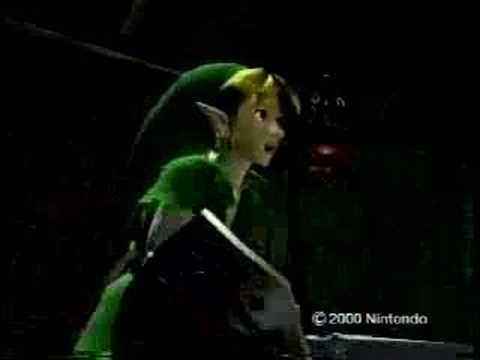
 The first thing that comes to mind is Legend of Zelda Wind Waker for the Nintendo Gamecube. When it was released in 2002 and 2003 at first the Nintendo community was outraged. They didn’t want the cartoony cell-shaded art style, although now it has a lot of love. The reason for this is that Nintendo gamers were promised far more when it came to the Gamecube’s Zelda title. At the Spaceworld event in 2000 gamers were shown this ; 


 A 3D Link with a similar design to the Link players knew and loved from the N64 era, looking marvelous in the new Gamecube graphics. But instead we got who is now lovingly called Toon Link. 
Using cell shading technology the Great Ocean in Wind Waker looked like a cartoon world, every character full of emotion. While gamers were outraged at the time, now Wind Waker is loved so much it got re released in HD on the Wii U (which doesn’t seem entire necessary but sure does it sell).

 Even though its not such a dirastic change, the art style in Bioshock Infinite is devine, and not just because it’s currently my favourite game of all time. The game was first designed with far more realistic faces and proportions on characters, but it was all changed for one reason. Emotion. Ken Levine, developer of Irrational Games and Bioshock Infinite decided to scrap using Motion Capture for the faces of the characters because he believed that animating the facial features of Elizabeth by hand would make her have far more character and emotion. You can see her more proportioned face before hand in early art and oddly enough in the televised trailer for Bioshock Infinite. 

 Personaly, I think this choice was amazing. Elizabeth, your companion throughout the whole game, is entirely important to the game, and her emotions doubly so. At any time in the game you can look at her and just see the look in her Disney like eyes and see her point of view. Brilliant choice.

 Similiarly, in Bethesda’s game Dishonoured every character has a far more caricature like appearance and the entire world has a more painted look. This graphical style makes the game far more interesting and stopped it from blending into obscurity.


 It’s interesting to me how now a practically photo-realistic human could be made in video games and yet sometimes going away from that look can make a far more interesting graphical style.

Thursday, 14 November 2013

History 2 - RAW! JAGUAR!


 In the early 90s the video game market was owned by Nintendo and Sega. The Super Nintendo Entertainment System and the Sega Genesis were the two major consoles on the market, both consoles being 16 bit systems. The early 90s was a period of time called the Bit Wars by some. Many people didn't even know what Bits were aside from better graphics, but they knew they wanted more bits. In basic terms, having the amount of bits a system had meant how many bits one element could handle at a time, more bits meant a faster system with better capabilities. This meant that advertising was filled by talk of bits.

Now Atari in the past used to be king of the video game industry, but were falling behind in the Console wars right now. But just like in life, in the console wars when you play the game of thrones you win or you die. But Atari had experience and age on their side. Their attempt to get back the crown of console gaming, which currently was being shared by mostly Nintendo and Sega, is something that really interests me. That's mostly why I'm doing one of these big blog posts about it, obviously.

 The Atari Jaguar!

 First of all, what a brilliant name for a console. It sounded aggressive and badass, the perfect name for a console trying to regain the crown! It was released over a year between 1993 and 1994 with a mass of advertising campaigns, all boasting one key thing about the Jaguar. It was a 64 bit console. This first came out in America far before the Sony Playstation which was still only a 32 bit system, and the N64 another 64 bit system wouldn't come out for a couple more years. So obviously they wanted to advertise the 64 bit system! And they did. Hilariously.


They even insulted the other systems:


 Now why wasn't the Jaguar a super success? Because it wasn't actually 64 bit. Well, it was and it wasn't . Technically, the Jaguar did have 64 bits of processing power, but it actually used a mix of processors, 32 and 16 bit, to add up to 64 bit. This ended up making the console actually weaker than the 32 bit Playstation, which Atari's CEO even admitted. So, people didn't like it. In 1995 after the release, Atari lost over half of their revenue. The stockholders were so frustrated Atari released this message to them :

From the introduction of Jaguar in late 1993 through the end of 1995, Atari sold approximately 125,000 units of Jaguar. As of December 31, 1995, Atari had approximately 100,000 units of Jaguar in inventory.


You would think after being so central to the Video Game Crash of the 80s that Atari would know better and would be able to avoid such a universal failure. That being said however, supposedly the Jaguar still has a very active fan-base, and home made games are still made for the system. So it's got that going for it, which is nice.

Friday, 8 November 2013

Now I need more practice in 3Ds Max. That much is obvious. But if you consider I've only been using the program for about 6 weeks, I think I'm doing rather okay. I just finished my old building project; I had chosen the stupidest building to build though. 
 (the photoshop overlays I used for the textures wont remove from the render though, so thats a slight worry.)
 I think its okay. It's not industry standard but it's okay, considering I'm still a student and all. I made alot of mistakes but really, if you don't make the mistakes how will you know how to avoid them? That's how I'm looking at it anyway. Next on my list is to watch a bunch of Mike Pickton videos on unwrapping and texturing, as for now that seems to be how I keep messing up. 

Tuesday, 5 November 2013

I need to get better at not losing things. This is like the 4th time I've left or lost a USB stick with work on it. Really what this SHOULD teach me is to back up my work more often so when this does happen, it wont waste about 4 hours of work. Ah well, at least I can learn some new things by re-doing it. Look on the bright side of life and all that jazz.

Saturday, 2 November 2013

The end of Gamings honeymoon phase


 The British public information series Protect and Survive, made in the late 1970s during the nuclear threat of the cold war, was voted number 89 in a Channel 4 poll of 100 scariest moments. This was above even Dracula. During the 1980s the cold war was terrifying, and at any time the entire world could of been obliterated in nuclear hellfire. I for one, am not interested in living in the Fallout Universe as a Ghoul.

 And that's what we're here to talk about isn't it? Video games. I already talked about the Magnavox Odyssey and how it shaped the gaming industry (sort of). Truth is the Odyssey started the idea of a cartridge based gaming system, which was then elevated to the level of godhood by the Atari 2600. In the early 80s the Arcades were the homeland of gaming.  Companies all over the world were trying to get in on the Arcade money by making home consoles. Everyone wanted to take the Arcade experience home, and with home consoles like the Atari 2600 that was possible!

 Unfortunately as everyone was trying to get in on taking the home console money, that lead to everyone making their own consoles. So many consoles being made is one of the key reasons for the 1983 Video Game crash, although there were other key factors of course.  One of the most hilarious reasons to me is the E.T. Game. Not only was this game so bad that most copies of the game were dumped in the desert, but it also cost Atari somewhere between 20-25 million dollars in trying to get the rights for the game.
 Out of the ashes came the Nintendo Entertainment System, the all holy NES. This started a key change in the market, where the main video game consoles were American in origin to Japanese, which didn't change back for some time. Now part of the problem with Atari is that almost anyone could make an Atari game and sell it en masse. Many games were literal advertisements, such as the Kool-Aid Man game, made purely to sell a product. Nintendo solved this problem by checking all third party developers and keeping them on a leash. Of course unlicensed games were still made, but Nintendo's efforts are thought to have stopped a second Market crash.


 Another great survivor of the Market Crash was the PC. Gaming as we know today formed from the 80s with the steps made by Nintendo and the new PC gaming industry. Such historic games as Zork and The Legend of Zelda started to form genres that we know and love today! PC's got more and more powerful, media PC's with more powerful screens and speakers made gaming on PC more and more able, eventually leading to games such as ID Softwares Wolfenstein 3D (which may of been made in 1992 but its pretty important), which were revolutionary and brilliant at the time. This generation of games with its monumental lows and highs set the stage for gaming for THE REST OF TIME!

Friday, 1 November 2013

So I just had my first big 3D Max crash. Luckily not too much work was lost, only like 1 hour as opposed to an entire lost project.

Saturday, 26 October 2013

History!


So this is a pretty cool thing, simply saying a whole load of old games are available online now in an easy and free way. Sweet huh? Pretty cool to look at how far games have come.